Why Canine VHH and Animal Health Nanobody Development Is Emerging
Animal health biotechnology is entering a more targeted era. Vaccines, antiparasitics, small molecules, commodity diagnostics, and broad-spectrum treatments still matter. They remain the backbone of veterinary medicine. But the next layer of growth is more molecular, more precise, and more product-specific.
This guide explains the emerging field of canine VHH and animal health nanobody development: what these compact antibody fragments are, why they matter in dogs and veterinary medicine, where they may be used, how they are manufactured, and why CDMO strategy has to be built around the animal, the product class, and the commercial model.
The opportunity is not simply to copy human biologics into pets, livestock, or aquaculture. Animal health has different economics, routes of use, regulatory pathways, dosing realities, and distribution systems.
Companion animal medicine can support more sophisticated biologics in areas such as dermatology, oncology, inflammation, pain, infection, and chronic disease. Veterinary diagnostics are becoming more recombinant, multiplexed, and point-of-care. Livestock and aquaculture need scalable tools for disease detection, surveillance, and field-stable performance.
Across all of these markets, the need is clear: compact, stable, engineerable binders that can be produced reliably, formulated practically, and matched to real animal-health use cases.

This is where canine VHH and animal health nanobody development begins to matter.
This guide is a deep dive into what animal health VHH development actually requires. It covers the biology of VHH nanobodies, why canine and veterinary applications are different from human biologics, how product class changes the CDMO path, and why expression, purification, analytics, formulation, stability, regulatory category, and final-use format all need to be considered early.
VHH nanobodies are single-domain antibody fragments derived from camelid heavy-chain-only antibodies. They are small, usually about 12–15 kDa, encoded by a single gene, and capable of high-affinity antigen binding without the paired heavy-chain and light-chain architecture of conventional IgG antibodies. Their structure gives them properties that are attractive for animal health: stability, modularity, recombinant manufacturability, microbial expression potential, and access to epitopes that larger antibodies may not reach.
The history begins in camelid immunology, not veterinary product development. In the early 1990s, researchers studying camelid antibodies found that camels and related species naturally produce functional antibodies that lack light chains. This challenged the standard antibody model, which treated heavy-chain and light-chain pairing as essential to antigen recognition. The discovery showed that one variable domain could function as a complete binding unit. That domain became known as the VHH, and VHH-derived binders later became widely discussed under the nanobody concept.
Human medicine adopted the technology first. VHHs became tools for structural biology, diagnostics, imaging, and therapeutics. Caplacizumab, a VHH-based therapeutic targeting von Willebrand factor, helped prove that a nanobody-derived product could become a regulated medicine.
Animal health has a different logic. A truly beautiful type of logic.
Animal health does not need a miniature version of human biologics manufacturing. It needs its own development logic: species biology, route of use, storage conditions, cost tolerance, regulatory category, and manufacturing scale.
The history is part of the point. VHH began as an oddity in camelid immunology — a small antibody domain from animals most people did not associate with modern biologics. That strange origin is exactly why the format now feels useful in veterinary markets: compact, modular, stable, and adaptable.
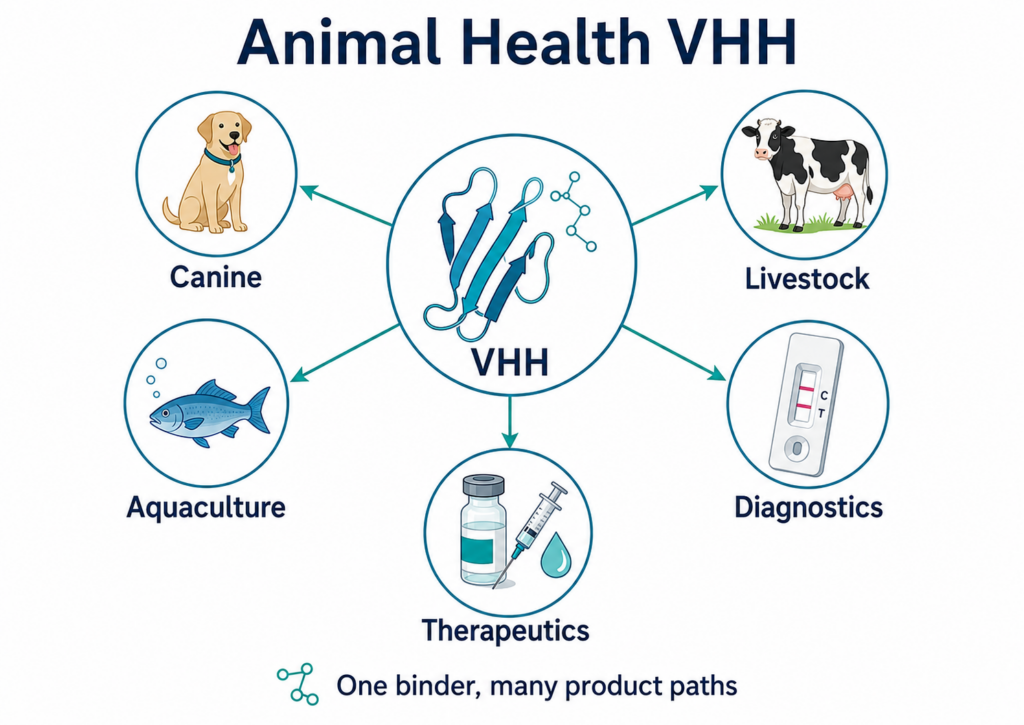
A canine VHH programme may become an injectable therapeutic, diagnostic reagent, topical pet-care ingredient, oral/local binder, QC tool, livestock surveillance reagent, aquaculture assay component, or targeting domain. These products may share a binder architecture, but they do not share a development path.
The real CDMO question is not “can you make the fragment?” It is:
- Which species?
- Which product class?
- Which route of use?
- Which expression host?
- Which purity standard?
- Which formulation?
- Which cost model?
A binder can still fail if it expresses poorly, aggregates, loses activity, carries endotoxin, breaks in formulation, underperforms in the final assay, or becomes too expensive for the market.
In animal health nanobody dev: discovery & manufacturing have to meet early.
The product defines the strategy.The strategy defines the CDMO path.
What Is a VHH Nanobody?
A VHH nanobody is a compact single-domain antibody fragment derived from the heavy-chain-only antibodies naturally produced by camelids, including camels, llamas, and alpacas. In a conventional IgG antibody, antigen binding is formed by the paired variable domains of a heavy chain and a light chain. The two domains create a binding surface together. A VHH is different. It is the variable domain from a heavy-chain-only antibody, and it can bind antigen independently without a light-chain partner.
That independence is what makes the VHH format so useful.

A conventional IgG antibody is large, around 150 kDa, and structurally complex. It requires correct heavy-chain and light-chain expression, assembly, disulfide bonding, and often mammalian cell production. By contrast, a VHH is much smaller, typically around 12–15 kDa. It is encoded by a single gene, which simplifies cloning, sequencing, library generation, expression screening, and engineering. A VHH does not require light-chain pairing. It does not need to be assembled into a full antibody to recognize antigen. It can often be expressed as a recombinant protein in microbial hosts such as E. coli or yeast, although expression system choice depends on the specific molecule and intended use.
Several structural features explain the appeal of VHHs. Their frameworks evolved to function without the light-chain interface that conventional VH domains normally depend on. As a result, VHHs often show strong solubility and stability compared with isolated conventional VH domains. Their complementarity-determining regions, especially CDR3, can form extended loops that may reach recessed, hidden, or enzymatic cleft-like epitopes that full antibodies cannot easily access. This makes them interesting not only as substitutes for conventional antibodies, but as binders with a distinct epitope-access profile.
VHHs are also modular. A single VHH can be used as a monomer. Multiple VHHs can be linked to create bivalent, trivalent, biparatopic, bispecific, or multispecific constructs. A VHH can be fused to an Fc domain for half-life extension or effector function. It can be fused to an albumin-binding domain, enzyme, toxin, cytokine, fluorescent protein, radionuclide chelator, nanoparticle surface, diagnostic label, or cell therapy receptor architecture. That modularity gives VHHs a broad design space across therapeutics, diagnostics, imaging, animal health, research tools, and industrial biotechnology.
In animal health, the properties of VHHs matter for practical reasons. Many veterinary products face tighter pricing constraints than human biologics. Distribution conditions may be less controlled. Field stability may matter more. The product may need to be shipped to clinics, farms, diagnostic labs, shelters, aquaculture sites, or decentralized testing locations. A molecule that is compact, stable, recombinant, and engineerable can be valuable in this context.
Canine VHH programs hit different.
Dogs crave advanced care—oncology, dermatology, chronic inflammation, pain, and specialty diagnostics. A VHH lets you craft something more precise than a small molecule, easier to sculpt than a full antibody, and deliciously flexible in expression and format.
But small doesn’t mean simple. Every VHH still demands real seduction: clean expression, proper folding, solubility, strong recovery, intact binding potency, controlled aggregation, tight impurities, and lasting stability in the final formulation’s intimate embrace. A research binder, diagnostic reagent, topical pet-care caress, or injectable therapeutic each desires its own tailored development path.
That’s why the VHH format lives at the lush intersection of antibody engineering, recombinant manufacturing, vet biology, formulation, and regulatory nuance. It makes animal health nanobody CDMO services a specialized art—not just another protein service.
Animal Health Biologics: Not Just Mini Human Versions
Animal health biologics aren’t smaller or cheaper human drugs. Species differ. Economics differ. Delivery routes differ. Regulations differ. A human oncology antibody plan rarely fits a canine dermatology product, livestock diagnostic, topical pet care binder, or aquaculture monitoring reagent.

1. Cost of Goods Human biologics often absorb high manufacturing costs thanks to pricing and reimbursement. Animal health is harsher. Premium canine oncology or chronic care products may justify it, but livestock, poultry, or aquaculture tools demand razor-thin COGS. Yield, recovery, purification, endotoxin control, formulation, stability, and supply chain decide real viability. Small size alone doesn’t guarantee low cost—process realities do.
2. Species Biology Human drugs target one species. Veterinary spans dogs, cats, horses, cattle, swine, poultry, fish, shrimp, and more. Target sequences, immune responses, half-life, proteases, and dosing all shift by species. A binder that hits human protein may miss the canine version entirely. Successful programs require species-specific engineering, native target validation, and tailored formats like canine Fc fusions or albumin-binding domains.
3. Product Class In animal health, the same scaffold becomes wildly different products: injectable therapeutic, diagnostic reagent, topical ingredient, assay component, toxin binder, or field-stable surveillance tool. Each demands its own path.
- Injectables need tight endotoxin, sterility, and potency control.
- Diagnostics prioritize lot consistency, conjugation, matrix performance, and dried stability.
- Topicals must survive surfactants, preservatives, and formulation chemistry.
- Livestock/aquaculture tools require low cost and extreme robustness.
Single-domain antibodies (nanobodies) shine here when the CDMO route matches the real-world use from day one.
The fourth difference is route of use. Human biologics often focus on injection, infusion, or controlled clinical administration. Animal health products may need subcutaneous injection, intradermal delivery, topical application, oral or gut-local delivery, intramammary use, in-clinic testing, barn-side testing, water-compatible formats, feed-associated delivery, dried diagnostics, swab-based sampling, milk testing, fecal testing, or environmental monitoring.
Each route changes the technical burden. A VHH intended for subcutaneous canine injection must be formulated around concentration, osmolality, viscosity, aggregation, endotoxin, particles, and sterility. A VHH used in a lateral flow assay must survive conjugation, drying, rehydration, membrane flow, matrix interference, and shipping stress. A VHH used in a dermatology wipe or spray must remain active in the actual formulation, not only in phosphate buffer. A VHH used for aquaculture surveillance may need to perform in water-exposed, field-use, or low-infrastructure conditions.
Stability pressure is also higher in many animal health categories. Human biologics often move through controlled clinical and pharmacy systems. Animal health products may pass through veterinary clinics, farms, shelters, feed channels, diagnostic labs, cold rooms, trucks, rural storage areas, or owner handling. Temperature excursions, humidity, agitation, freeze-thaw, light exposure, and inconsistent storage can matter. For diagnostics, dried reagent stability and shipping simulation may be more important than elegant binding data in buffer. For topical products, the protein must survive the final matrix. For livestock and aquaculture, field stability can decide whether the product has any commercial use.
The regulatory logic is also more fragmented. Animal health VHH products may fall into different categories depending on claim, geography, route, and product function. A product that diagnoses, prevents, treats, or modifies disease may face a different pathway than a research reagent, topical wellness ingredient, assay standard, or diagnostic component. A VHH used outside the animal in a veterinary diagnostic kit is not regulated like an injectable therapeutic. A VHH used as a biological component in a disease-treatment product is not the same as a purified RUO binder.
This is why product claims matter early. “Supports skin health,” “detects pathogen antigen,” “neutralizes toxin,” “treats canine dermatitis,” “reduces viral load,” “binds inflammatory mediator,” and “for research use only” are not equivalent development statements. Each claim can change the quality standard, analytical package, documentation burden, regulatory pathway, and CDMO fit.
The market also divides into several technical segments.
Companion animals, especially dogs and cats, are the most obvious near-term opportunity for higher-value biologics. Specialty veterinary medicine now includes oncology, dermatology, chronic inflammatory disease, pain management, allergy, endocrine disease, infectious disease, and advanced diagnostics. Dogs are especially important because canine medicine has clinical sophistication, owner willingness to pay, and disease areas where targeted biologics can make sense.
Les VHH, ou nanobodies, furent découverts par un hasard exquis en 1989 à Bruxelles. Des étudiants en biologie, chargés de séparer les chaînes lourdes et légères d’anticorps prélevés sur un dromadaire infecté par Trypanosoma evansi, observèrent avec stupeur que certaines immunoglobines fonctionnaient parfaitement sans aucune chaîne légère. Ces anticorps à chaîne lourde seule, issus de camélidés adaptés aux déserts extrêmes, révélaient une architecture minimaliste et résiliente, capable de plonger dans des crevasses moléculaires interdites aux anticorps classiques. Une élégance étrange et intime, née d’une sérendipité sauvage au cœur du sang d’un chameau malade.
Le CDMO Network accompagne tout type de sponsor avec expertise et souplesse ; n’hésitez pas à nous contacter.
Canine VHH products could be therapeutic binders, diagnostic reagents, topical skin products, oral-local gut binders, imaging agents, checkpoint-targeting domains, cytokine binders, toxin neutralizers, or companion diagnostic components. But every category has a different manufacturing route. A canine oncology VHH-Fc fusion may require mammalian expression and biologics-style analytics. A canine lateral flow binder may need microbial expression, conjugation testing, and dried reagent stability. A canine dermatology VHH may need topical formulation screening more than clinical-style fill-finish.
Horses are another high-value animal health category, but equine products have different constraints. Dose size, body weight, route of administration, anti-drug antibody risk, performance-animal rules, withdrawal concerns where relevant, and clinical use conditions differ from small-animal medicine. An equine biologic may require larger fill volumes, different concentration strategy, different stability assumptions, and different commercial pricing logic.
Livestock markets are more constrained by herd economics. Cattle, swine, poultry, sheep, and goats require population-level thinking. Disease monitoring, pathogen detection, toxin detection, productivity, prevention, vaccine support, and surveillance often matter more than individualized biologic treatment. In these settings, VHHs may be more attractive as recombinant diagnostic binders, field-stable reagents, pathogen-capture tools, toxin binders, assay standards, or low-cost detection components than as expensive injected therapeutics.
Poultry and swine applications are especially cost-sensitive. A product may need to work across very large animal populations where cost per animal or cost per test is tightly controlled. A VHH format that looks attractive scientifically may fail commercially if expression yield, purification simplicity, formulation stability, or kit cost is not aligned with the production model.
Aquaculture is different again. Fish and shrimp health markets need disease surveillance, pathogen detection, biosecurity support, and scalable tools for water-based production systems. Delivery is difficult. Cold-chain dependence is a problem. Environmental robustness matters. VHHs may be relevant as diagnostic binders, pathogen-monitoring reagents, water-compatible assay components, or specialized local biological tools, but the model cannot assume companion-animal pricing.
Veterinary diagnostics may be the cleanest entry point for many animal health VHHs. Diagnostic products value recombinant consistency, specificity, stability, low background, conjugation compatibility, and repeatable lot production. VHHs can be useful as capture binders, detection binders, assay controls, calibrators, conjugated reagents, lateral flow components, ELISA reagents, biosensor binders, multiplex panel components, and microfluidic cartridge reagents.
The technical burden for diagnostics is specific. A VHH must not only bind. It must perform in the final assay architecture. It may need to tolerate gold nanoparticle conjugation, latex particle conjugation, fluorescent labeling, enzyme conjugation, biotinylation, immobilization, drying, rehydration, nitrocellulose flow, pad chemistry, microfluidic surfaces, or magnetic bead formats. It may need to work in serum, plasma, saliva, nasal swabs, fecal extract, wound fluid, milk, water, tissue lysate, or environmental samples.
That is why affinity is not enough. A VHH with strong SPR kinetics can still fail in a lateral flow strip. A binder with good ELISA signal can fail after conjugation. A reagent that works in buffer can fail in milk, feces, saliva, or hemolyzed samples. Diagnostic VHH development requires assay-format realism early.
Topical animal health VHHs are another niche but important category. Canine dermatology, oral care, wound care, skin barrier support, allergy-associated pathways, microbial targets, and pet-care formulations may create opportunities for local VHH use. These products may not need the same path as injectable biologics, but they face harsh formulation environments. Surfactants, preservatives, oils, polymers, fragrances, solvents, pH, viscosity modifiers, and packaging materials can destabilize proteins. A VHH that is stable in clean buffer may lose activity in a wipe, shampoo, spray, cream, gel, foam, or oral-care matrix.
Oral and gut-local animal health VHHs require another development logic. Systemic oral delivery of intact proteins is difficult because of gastric acid, proteases, bile salts, food effects, mucus, residence time, and epithelial barriers. But local gut activity is different. A VHH designed to bind a toxin, pathogen antigen, microbial surface structure, inflammatory mediator, or luminal target may not need systemic absorption. That opens a different product category: protected local binders, enteric formats, microencapsulated proteins, dried powders, engineered microbial delivery, or feed-adjacent concepts. These programs need simulated gastric/intestinal testing, protease challenge, bile exposure, activity recovery, and realistic site-of-action assays.
Animal health is brutally tied to manufacturing economics.
A human biologic may justify a complex process. A livestock test, aquaculture reagent, or topical pet product often will not. Titre, resin use, purification steps, endotoxin control, lyophilisation time, packaging, cold chain, and shipping all hit the product model.
VHHs can be a strong fit because they may express microbially, stabilise well, dry well, and work as recombinant binders. But that is not automatic. Some express poorly, aggregate, lose activity, need mammalian expression, or become costly once GMP, release, formulation, and fill-finish are added.
The right model is product-specific:
- canine therapeutic: species biology, potency, exposure, sterility, dosing
- diagnostic binder: assay signal, matrix tolerance, conjugation, dry stability
- topical product: final formulation survival
- livestock reagent: cost and field robustness
- aquaculture binder: deployment and surveillance economics
- RUO reagent: fast, reliable supply without overbuilt quality
Animal health nanobody development is not one lane. It is several product worlds sharing one binder format.
Start with the animal, use case, route, claim, and economics. Then choose the CDMO.
Why Dogs May Lead the Next Animal Health Nanobody Wave
Everyone in finance and venture capital who invest in biotech, pharma, biopharma should be aware of this. Dogs are probably one of the best near-term markets for animal health nanobody development.
Not because canine biology is easy. It is not.
The reason is simpler: dogs sit in the premium zone of veterinary medicine. Owners already pay for specialty care, chronic disease treatment, oncology, dermatology, allergy management, diagnostics, surgery, pain control, and long-term medication. That creates room for products that would be too expensive or too complex for many livestock or commodity animal-health markets.
In plain terms: the dog market can handle more sophisticated biology.
The big canine opportunities in the marktet today
- Dermatology and allergy
Skin disease is a major companion-animal category. Targeted binders could support local therapy, topical products, immune modulation, or diagnostic stratification. - Inflammation and chronic disease
Many canine conditions involve cytokines, receptors, ligands, and immune pathways. That is exactly where targeted binding can matter. - Oncology
Dogs develop real, spontaneous cancers that are clinically treated. Nanobody-style formats may be useful as targeting domains, imaging agents, diagnostic reagents, or therapeutic binders. - Pain and immune modulation
A binder that blocks a receptor or neutralises a ligand could fit chronic veterinary care, but only if dosing, half-life, safety, route, and cost make sense. - Diagnostics
This may move faster than therapeutics. Canine tests need reliable recombinant binders for lateral flow, ELISA, biosensors, multiplex panels, and point-of-care formats. - Gut and oral health
Microbiome, dental, inflammatory bowel, toxin-binding, and local gut applications are interesting, but oral delivery is still a tough game. - Topical pet-care
Sprays, wipes, creams, gels, foams, and shampoo-like products could become a distinctive category if the molecule survives the formulation.
The catch
A canine product is not just a human biologic dropped into a dog.
Species matters.
The target may differ. Tissue expression may differ. Immune response may differ. Half-life may differ. Fc biology may differ. Albumin binding may differ. Route, dose, safety, and owner economics are different too.
That means canine VHH development is not only a binding problem. It is a species-specific product engineering problem.
The development reality
A molecule may bind beautifully in the lab and still fail because:
- it clears too fast
- it aggregates
- it expresses poorly
- it does not survive formulation
- it cannot be made cheaply enough
- it loses potency after conjugation
- it fails in the final diagnostic assay
- it needs half-life extension that changes the manufacturing route
- it looks canine-compatible on paper but performs worse after engineering
This is why caninization matters, but also why it should not be treated like magic. Making a binder “more dog-like” can help reduce species mismatch, but sequence changes can also damage affinity, solubility, expression, purification, stability, or potency.
What Exactly Is VHH Caninization?
Caninization is the process of engineering a canine-compatible antibody fragment while preserving the traits that make it useful: binding, specificity, solubility, expression, stability, potency, and manufacturability.
It is similar in concept to antibody humanization, but it is not a copy-paste exercise. Dogs have their own immune biology, product-use cases, dosing realities, and veterinary regulatory logic.
The goal is simple:
- reduce species mismatch
- preserve binding and potency
- avoid new developability problems
- keep the molecule manufacturable
- match the engineering strategy to the product class
Caninization matters most when the molecule actually meets the dog’s immune system: injections, chronic biologics, local therapies, or exposed topicals.
For diagnostics used outside the animal, it may not matter much.
But don’t over-romanticize it. “More canine-like” does not always mean better. Tiny sequence edits can mess with folding, expression, purification, binding, aggregation, and formulation.
Key risks include:
- Binding loss — framework changes can shift CDR loop positioning.
- Lower expression — engineered variants may perform worse in E. coli, yeast, or mammalian systems.
- Higher aggregation — sequence edits can expose hydrophobic or unstable regions.
- Purification changes — charge, pI, surface profile, and product variants may shift.
- Stability loss — heat, freeze-thaw, concentration, and formulation behaviour can worsen.
- Potency drift — binding may remain, but functional activity can fall.
A practical workflow usually includes:
- starting sequence review
- liability and developability analysis
- canine framework or sequence strategy
- variant design
- expression screening
- binding confirmation
- aggregation and stability testing
- purification assessment
- functional potency testing
- formulation and product-class review
The strongest programmes do not treat caninization as cosmetic sequence editing. They treat it as species-aware product engineering.
A caninized VHH still has to become a real veterinary product: expressible, stable, functional, scalable, and appropriate for its intended canine use.
Expression yield may change. A caninized variant may express worse in E. coli, Pichia, yeast, or mammalian cells than the original binder. This matters because animal health products often need practical manufacturing economics.
Purification behavior may change. Charge profile, isoelectric point, surface patches, tag behavior, and product-related variants can shift after engineering. A purification process developed for the original sequence may not transfer to the caninized version.
Stability may improve or worsen. A caninized candidate may show lower thermal stability, increased fragmentation, higher aggregation after freeze-thaw, or poor behavior at the concentration required for dosing.
Potency must be reconfirmed. Binding assays are not always enough. If the VHH blocks a receptor, neutralizes a toxin, inhibits a ligand, or modulates a pathway, functional potency must be tested after engineering.
A practical caninization workflow usually begins with the starting VHH sequence or binder panel. The first step is sequence and liability review. This may include analysis of unusual residues, cysteine patterns, glycosylation motifs, deamidation risks, oxidation-sensitive residues, hydrophobic patches, aggregation predictions, and developability flags.
Next comes canine framework or compatibility assessment. The goal is to identify engineering options that reduce species mismatch while preserving the structural features required for binding. Several variants may be designed rather than betting on a single modified sequence.
Expression screening follows. Multiple caninized candidates should be tested in the intended or likely expression system. For a simple monomer, this may include E. coli or Pichia. For an Fc fusion or more complex format, mammalian expression may be needed. Expression screening should evaluate not just titer, but soluble yield, product integrity, purity after initial purification, and activity.
Binding and potency confirmation come next. The caninized VHH must be compared against the parent binder. If affinity drops, the sponsor must decide whether the improved species compatibility is worth the loss, whether affinity maturation is required, or whether another variant should advance.
Developability ranking should then combine binding, expression, solubility, purity, aggregation, stability, formulation behavior, and manufacturability. The “best” caninized VHH is not always the highest-affinity clone. It is the candidate most likely to become a stable, manufacturable, useful animal health product.
Manufacturability evaluation then becomes more specific. Can the VHH be produced at the required scale? Is the purification process realistic? Does endotoxin matter? Is the quality standard research-grade, diagnostic-grade, GMP-aligned, veterinary-grade, or full GMP? Does the product need sterile fill-finish, lyophilization, topical formulation, or kit assembly?
The key lesson is that caninization is not only an immunology question. It is also a manufacturing question. Any sequence modification that changes recognition can also change expression, purification, formulation, stability, and scale-up. For canine VHH programs, species engineering and CDMO strategy should be connected from the beginning.
Major Animal Health Nanobody Product Categories
Animal health nanobody development covers several product categories that should not be collapsed into one generic label. The same VHH architecture can support therapeutic, diagnostic, topical, oral/local, livestock, and research-tool applications. But each category has different technical risks, quality standards, timelines, and CDMO needs.
1. Therapeutic Canine VHHs
Therapeutic canine VHHs are designed to act directly in the animal. They may target inflammatory mediators, immune receptors, tumor markers, microbial toxins, pathogen antigens, pain pathways, or tissue-specific proteins. These products require the strongest biological and manufacturing discipline because the VHH is not merely a reagent; it is part of a therapeutic intervention.
A therapeutic canine VHH may be monomeric, bivalent, bispecific, Fc-fused, albumin-binding, PEGylated, conjugated, or formulated for local delivery. The format depends on the target and desired pharmacokinetics. Monomeric VHHs may clear rapidly, which can be useful for imaging or short-action applications but problematic for chronic therapy. Fc fusion or albumin binding can extend exposure but changes expression system choice, purification strategy, analytics, and possibly effector biology.
Therapeutic programs need potency assays, impurity control, stability testing, formulation work, safety planning, and a quality framework appropriate to the route and regulatory path. If the product is injectable, endotoxin, sterility, particles, container compatibility, and release testing become central.
2. Veterinary Diagnostics
Veterinary diagnostics may be the most practical near-term animal health use for VHHs. Diagnostic VHHs can act as capture binders, detection binders, assay standards, conjugated reagents, or positive-control materials. They may be used in ELISA, lateral flow assays, biosensors, multiplex panels, immunoassays, microfluidic cartridges, or companion diagnostic platforms.
The manufacturing priority is different from therapeutics. A diagnostic VHH must be reproducible, stable, assay-compatible, and cost-effective. It may need to tolerate conjugation to enzymes, fluorophores, gold particles, latex beads, magnetic particles, or biotin. It may need to perform after drying on a strip, immobilization on a surface, storage in a kit, or exposure to biological matrices such as serum, saliva, feces, milk, or swabs.
Low background is critical. A VHH that binds beautifully in a clean biochemical assay may fail in a lateral flow or ELISA format because of nonspecific binding, matrix interference, weak signal, poor conjugation orientation, or lot variability.
3. Topical and Dermatology Products
Canine dermatology is a commercially important category because skin disease, itching, allergy, infection, and inflammation are common in dogs. A VHH-based topical product could theoretically target microbial antigens, inflammatory mediators, toxins, allergens, or skin-associated biological pathways.
Topical VHH development is not simply therapeutic development with a different container. The formulation environment can be harsh for proteins. Gels, sprays, creams, wipes, shampoos, and foams may contain surfactants, preservatives, fragrances, solvents, viscosity modifiers, oils, or pH conditions that affect protein stability. The VHH must retain activity in the final matrix, remain stable over shelf life, avoid problematic degradation, and perform at the site of use.
For topical pet-care products, regulatory classification also matters. A product may be positioned as cosmetic, wellness, dermatologic, therapeutic, antimicrobial, or veterinary medicinal depending on claims and region. The manufacturing and documentation path changes accordingly.
4. Oral or Gut-Targeted VHHs
Oral VHH delivery is difficult because proteins are vulnerable to low pH, proteolytic enzymes, bile, food effects, and variable gastrointestinal transit. Systemic oral delivery of an intact VHH is a major challenge. But local gut-targeted VHH activity is a different concept. If the target is in the gut lumen, on a pathogen, on a toxin, or near a mucosal surface, the VHH may not need systemic absorption.
Gut-targeted VHHs could be explored for microbiome-related applications, toxin neutralization, pathogen binding, inflammatory bowel disease concepts, or oral health products. These programs require formulation protection, activity testing under simulated gastric and intestinal conditions, stability analysis, and realistic claims about exposure.
5. Livestock and Herd Health Applications
Livestock applications include cattle, swine, poultry, sheep, goats, and related agricultural species. Here, economics dominate. Products must often work at large scale, low unit cost, and practical storage conditions. VHHs may be useful as diagnostic binders, pathogen-detection reagents, toxin binders, herd-monitoring tools, assay standards, or possibly localized biologic interventions.
A livestock VHH product must be manufacturable. High yield, simple purification, field stability, and low cost of goods are often more important than elegant molecular design. If the product cannot meet herd-level economics, the biology may not matter commercially.
6. Research Tools and Veterinary Assay Reagents
Many animal health VHH programs will begin as research tools or assay reagents. A company or academic group may need a custom binder against a canine target, livestock pathogen, veterinary biomarker, or species-specific protein. These VHHs may support target validation, assay development, QC testing, biomarker research, or diagnostic prototyping.
Research-tool VHHs do not need the same quality system as therapeutics, but they still need reliable production. Purity, activity, identity, stability, and repeat supply matter. A weak research reagent can damage downstream assay development just as surely as a weak therapeutic candidate can damage a clinical program.
Across all categories, the same rule applies: product class defines manufacturing path.
Animal health nanobody CDMO services must begin by identifying what the VHH is supposed to become.
Expression Systems for Canine VHH and Animal Health Nanobody Manufacturing
Expression system selection is one of the most important technical decisions in canine VHH and animal health nanobody manufacturing. The expression host determines cost structure, timeline, impurity profile, folding environment, scalability, purification burden, regulatory fit, and sometimes the final product format. There is no universal best host.
The right system depends on the VHH sequence, intended species, product class, route of use, quality standard, scale, and budget.
E. coli Expression
E. coli is one of the most common systems for VHH production. It is fast, inexpensive, genetically tractable, and widely used for recombinant protein expression. For simple monomeric VHHs, research reagents, diagnostic binders, and some therapeutic candidates, E. coli can be an attractive starting point.

The major technical decision is where the VHH is expressed. Periplasmic expression can support disulfide bond formation and may produce properly folded soluble protein.
Cytoplasmic expression can sometimes produce higher yield but may create folding challenges, depending on the VHH and strain. Inclusion body expression can generate large amounts of protein, but the material must be solubilized and refolded, which can reduce recovery and increase development burden.
E. coli also introduces endotoxin. For research tools or certain diagnostic uses, endotoxin may be manageable or less central. For injectable therapeutic use, cell-based assays, sensitive biological systems, or regulated products, endotoxin control becomes a major requirement. Host-cell proteins, host-cell DNA, product fragments, misfolded variants, and aggregates must also be addressed.
The advantage of E. coli is speed and cost. The risk is that a fast expression result can hide downstream problems. A VHH that expresses well in E. coli may still require extensive purification development, endotoxin reduction, formulation screening, or transfer into another host.
Pichia / Komagataella Expression
Pichia pastoris, now commonly classified under Komagataella phaffii, is another important system for VHH production. Yeast expression can support secretion, high-cell-density fermentation, and scalable recombinant protein manufacturing. For animal health products where cost, scale, and secretion are attractive, Pichia can be a strong option.
Secreted expression is often the appeal. If the VHH is secreted into the culture medium, recovery may be simpler than intracellular bacterial expression. Yeast can also support scalable fermentation infrastructure and may reduce some endotoxin concerns associated with Gram-negative bacterial systems.
But Pichia is not automatically superior. Secretion efficiency varies by sequence. Proteolysis can damage the product. Glycosylation or other heterogeneity risks may matter, depending on the molecule. Methanol induction can create process and facility considerations, although alternative promoters and methanol-free systems exist. Downstream purification still matters because host-cell proteins, media components, fragments, and product-related variants can affect quality.
For animal health, Pichia may be especially interesting when the product needs more scale than a research reagent but cannot carry the cost of mammalian production. It may fit diagnostic VHHs, veterinary reagents, topical or local products, and some therapeutic concepts, provided the product expresses cleanly and remains stable.
Mammalian Expression
Mammalian expression is usually not the first choice for a simple monomeric VHH if microbial expression works. However, it may be necessary or preferred for more complex formats. VHH-Fc fusions, secretion-sensitive products, multispecific biologics, fusion proteins, and constructs requiring mammalian-style processing may need CHO or another mammalian system.
Mammalian expression changes the development economics. Timelines are often longer. Cost is higher. Cell line development, clone selection, media optimization, viral safety strategy, glycosylation assessment, and biologics-style purification may be required. For some animal health products, this may be too expensive. For high-value canine therapeutics, complex biologics, or products where Fc biology matters, it may be justified.
The key is to avoid reflexive decisions. A mammalian system may overcomplicate a simple diagnostic VHH. A microbial system may under-support a VHH-Fc therapeutic. The host must match the molecule and the market.
Choosing the Right Host
Yo, slow down before you pick the expression host!
It is not just “where do we make the VHH?”
It is “what kind of product are we actually building?”
Remember the big 5:
- Use case — diagnostic, injection, topical, livestock, or research tool
- Format — simple VHH, fusion, Fc, conjugate, or multivalent build
- Quality level — RUO, diagnostic-grade, veterinary-use, or GMP
- Cost and scale — cheap repeat supply or high-control biologics path
- Final product reality — stability, purification, endotoxin, formulation, shelf life
A diagnostic binder, injectable canine therapy, topical pet product, and livestock reagent do not need the same manufacturing setup.
The host is not just a production choice. Seriously, it decides the whole entire road.
VHH Purification Is Where the Product Becomes Real
VHHs began as an accident of immunology: camelids were found to carry heavy-chain antibodies without conventional light chains. From that odd biology came the single-domain binder — small, stable, engineerable, and unusually useful. But in canine VHH and animal health nanobody development, the discovery story is only the beginning.
Expression proves the molecule can be made. Downstream processing proves whether it can become a product.
A crude lysate with binding activity is not enough. The VHH must be recovered, purified, concentrated, buffer-exchanged, characterised, stabilised, and released in a form that matches its final use.
The purification route depends on the host:
- E. coli may require lysis, clarification, endotoxin control, refolding, or impurity removal.
- Pichia / Komagataella may simplify secretion but add protease, media, fragment, and heterogeneity challenges.
- Mammalian systems may be needed for VHH-Fc or fusion formats, bringing Protein A, polishing, viral safety, glycosylation, and charge-variant questions.
The product class then defines the standard.
A research VHH demands little beyond identity, purity, concentration, and binding activity.
A diagnostic nanobody requires consistent lots, reliable conjugation, dried-reagent stability, and robust performance across matrices.
A topical veterinary binder must endure intimate contact with creams, gels, sprays, surfactants, preservatives, and packaging materials.
An injectable canine therapeutic demands rigorous control of endotoxin, sterility, aggregates, subvisible particles, potency, formulation stability, and full documentation.
This is where small proteins reveal their hidden costs. A VHH may express eagerly yet recover poorly. It can purify elegantly, only to aggregate under concentration’s pressure. It binds cleanly in buffer, yet falters after conjugation, lyophilization, or demanding formulation. A simple monomer flows smoothly; a fusion, bispecific, or multivalent embrace introduces fresh tensions in manufacturing.
Endotoxin remains the sharpest divide. For E. coli-derived material, it cannot be an afterthought. It must be woven into every step—harvest, clarification, chromatography, buffers, filtration, and handling—especially for injectables.
The essential truth: purification must follow the product’s own desires, not rigid habit.
A canine therapeutic, livestock diagnostic, topical pet-care binder, and RUO reagent may all begin as single-domain antibodies, yet each craves its own tailored CDMO path. Animal health nanobody services should align expression, purification, analytics, formulation, endotoxin control, and intended use before committing to the wrong intimate manufacturing embrace.
Analytical Development for Animal Health VHHs
Analytical development is the control system of an animal health VHH program. It defines what was made, how pure it is, whether it still binds, whether it still functions, and whether the batch can be released for its intended use.
Without analytics, a canine VHH is only a protein prep. With the right method stack, it becomes a defined product candidate.
Core Analytical Layers
- Identity
- Confirms the expressed molecule is the intended VHH or engineered format.
- Methods may include intact mass, peptide mapping, sequence confirmation, SDS-PAGE, CE-SDS, N-terminal analysis, tag confirmation, tag-removal verification, and molecular weight assessment.
- Purity and product variants
- Defines monomer, fragments, dimers, aggregates, charge variants, and process-related impurities.
- Common tools include SEC-HPLC, RP-HPLC, IEX, CE-SDS, capillary electrophoresis, SDS-PAGE, and LC-MS.
- SEC-HPLC matters because even small VHHs can dimerize or aggregate after concentration, stress, fusion, conjugation, or formulation changes.
- Potency
- Binding is not always potency.
- A diagnostic VHH may need capture or detection performance.
- A therapeutic canine VHH may need receptor blocking, ligand neutralization, enzyme inhibition, toxin neutralization, cell binding, or target engagement.
- A delivery VHH may need to retain binding after conjugation, surface display, or particle attachment.
- Binding and functional assays
- Useful platforms include ELISA, SPR, BLI, flow cytometry, immunoassays, cell-binding assays, and mechanism-specific bioassays.
- The assay has to match the biology.
- A VHH can look strong by SPR and still fail in lateral flow, tissue binding, matrix performance, or native canine target recognition.
- Process-related impurities
- E. coli VHHs may require endotoxin, HCP, host-cell DNA, residual reagent, bioburden, and sterility testing depending on use.
- Yeast VHHs require HCP, DNA, proteolysis, and product-variant controls.
- Mammalian VHH-Fc or fusion formats may need biologics-style analytics, including glycosylation, charge variants, and higher-order structure where relevant.
Product-Specific Analytical Logic
- Veterinary diagnostics
- Focus: sensitivity, specificity, background, reproducibility, conjugation efficiency, matrix stability, and lot-to-lot signal.
- Relevant matrices may include serum, plasma, saliva, fecal extract, milk, nasal swabs, wound samples, or environmental samples.
- A binder that works only in buffer is not yet a diagnostic reagent.
- Topical and dermatology VHHs
- Focus: activity in final matrix.
- The VHH must tolerate pH, surfactants, preservatives, viscosity modifiers, excipients, packaging materials, and storage stress.
- Gel, spray, cream, wipe, and shampoo-style formats need formulation-linked analytics, not only purified-protein testing.
- Therapeutic canine VHHs
- Focus: identity, purity, potency, aggregation, endotoxin, stability, release criteria, and clinical or veterinary-use suitability.
- Potency should reflect the mechanism, not just target binding.
- Lyophilized or dried formats
- Focus: residual moisture, cake appearance, reconstitution time, potency recovery, aggregation, and post-reconstitution stability.
- Diagnostic dried reagents may also need heat stress, humidity challenge, and shipping simulation.
Stability-Indicating Analytics
Stability methods should detect the changes that actually matter:
- degradation
- fragmentation
- aggregation
- oxidation or chemical modification
- activity loss
- conjugate instability
- matrix failure
- loss of assay signal
- loss of potency after storage or shipping
The Right Analytical Package
Animal health VHH analytics should be practical, not inflated.
The goal is not to copy a human biologics package. It is to prove the molecule is real, stable, functional, reproducible, and fit for its actual use.
Under-testing hides risk.
Over-testing burns capital.
The right analytical strategy sits right between both.
Formulation and Stability: The Practical Animal Health Problem
VHHs have a reputation for stability. Fairly earned, but often overstated.
Stable in buffer is not the same as stable in product.
Le vrai test is not the molecule in isolation. It is the molecule in use.
A canine VHH or animal health nanobody must survive its final world:
- Injection — concentration, aggregation, osmolality, pH, endotoxin, sterility, particles, container contact, shelf life.
- Diagnostics — conjugation, drying, membrane behaviour, matrix effects, background signal, lot consistency, rehydration.
- Topicals — gels, sprays, wipes, creams, foams, surfactants, preservatives, oils, polymers, packaging, skin contact.
- Oral or gut-targeted formats — acid, proteases, bile salts, food effects, transit time, local exposure.
- Livestock and aquaculture — heat, humidity, transport, field use, cold-chain limits, cost discipline.
- Lyophilised products — cycle design, lyoprotectants, residual moisture, reconstitution, activity recovery.
Formulation is not decoration after purification. It is part of product architecture.
A binder may look elegant in discovery and fail in a vial, strip, spray, capsule, cream, or field test. The best candidate is not simply the strongest binder. It is the one that survives the commercial form.
Fait scientifique intéressant : les VHH, souvent appelés nanobodies, viennent d’anticorps naturellement présents chez les camélidés, comme les lamas et les alpacas. Leur particularité est leur taille minuscule : ils ne possèdent qu’un seul domaine de liaison, ce qui leur permet d’atteindre des cibles parfois difficiles d’accès pour les anticorps classiques. Cette architecture compacte les rend attractifs pour les diagnostics vétérinaires, les tests rapides, les produits biologiques pour animaux, et certaines approches thérapeutiques locales. En santé animale, leur intérêt ne réside pas seulement dans la biologie, mais dans leur capacité à devenir des produits stables, reproductibles et industrialisables. Le vrai défi commence donc après la découverte du binder : expression, purification, formulation, stabilité et choix du bon partenaire CDMO. C’est précisément là que CDMO Network aide les programmes à passer de l’idée scientifique à une stratégie de développement concrète.
CDMO Strategy for Canine VHH and Animal Health Nanobody Programs
CDMO strategy for canine VHHs starts with product definition.
The wrong first question is: who can express this VHH?
The better question is: what is this VHH supposed to become?
A canine therapeutic, diagnostic binder, topical pet-care ingredient, livestock assay reagent, oral gut-targeted protein, and RUO research tool may all begin as VHHs. But they are not the same CDMO program.
Core Strategy Questions
- Product class
- Therapeutic
- Veterinary biologic
- Diagnostic reagent
- RUO tool
- Topical ingredient
- Assay standard
- Targeting domain
- Early research material
Product class defines the quality burden. A diagnostic VHH needs assay consistency. A topical VHH needs formulation compatibility. A canine injectable needs endotoxin control, sterility strategy, potency, and stronger documentation.
- Species fit
- Dog-specific target
- Cross-reactive companion animal target
- Livestock target
- Canine sequence homology
- Native target recognition
- Caninization need
- Species-specific immunogenicity risk
A binder can look good on recombinant antigen and still fail against the real canine target.
- Molecular format
- Monomeric VHH
- Bivalent VHH
- Biparatopic VHH
- Bispecific or multispecific VHH
- VHH-Fc
- Albumin-binding format
- Enzyme fusion
- Conjugated VHH
- Nanoparticle-targeting ligand
Format changes everything: host choice, folding, purification, aggregation risk, analytics, formulation, and final product controls.
- Expression host
- E. coli for speed, cost, and microbial production
- Pichia / Komagataella for secretion and scale
- Mammalian expression for Fc fusions or complex biologics
- Alternative systems when impurity profile, folding, or product economics demand it
The host should follow the product. Not the vendor’s favourite platform.
- Quality standard
- Research-grade
- High-purity non-GMP
- Diagnostic-grade
- ISO-aligned
- GMP-aligned
- Veterinary-grade
- Full GMP
These are not interchangeable. Overbuilding quality wastes money. Underbuilding quality forces redevelopment.
- Quantity and scale
- Milligrams for screening or assay work
- Grams for animal studies or diagnostic development
- Kilograms for commercial reagent supply
- Small high-quality batches for rare canine indications
- Low-cost repeatable batches for livestock diagnostics
Animal health scale is not automatically human mAb scale. The economics are different.
- Downstream and analytics
- Purification recovery
- Endotoxin control
- HCP and DNA clearance
- Aggregation profile
- Potency assay
- Matrix performance
- Stability
- Formulation compatibility
- Tech transfer readiness
Expression alone is not enough. A CDMO that can make protein but cannot control impurities, activity, or stability can create a handoff problem.
Common CDMO Mismatches
- Low-cost expression vendor chosen for a future injectable product
- Human biologics GMP site used for a simple diagnostic VHH
- Microbial expression selected without endotoxin strategy
- Discovery vendor delivers binders without manufacturability ranking
- Topical VHH team delays formulation until the process is locked
- Diagnostic team selects by affinity before testing conjugation and assay behavior
- Sponsor chooses the largest CDMO instead of the best-fit CDMO
The Right CDMO Strategy
Good CDMO strategy is architectural.
It defines:
- what capabilities are needed now
- what capabilities will be needed later
- which early decisions create downstream risk
- which CDMO fits the molecule, species, product class, quality level, budget, and commercial path
For canine VHH and animal health nanobody programmes, manufacturing is strategy, not procurement. It shapes the candidate, analytics, formulation, regulatory path, and commercial viability.
Common Failure Points in Canine VHH and Animal Health Nanobody Development
Most animal health nanobody failures are not biology failures. They are development architecture failures. The binder may work. The target may matter. The market may exist.
The programme still fails when expression, purification, analytics, formulation, or product class are solved way too late.
Some Common failure points
Core lesson
- Strong binding, weak expression
High affinity is not enough if the molecule expresses poorly in the chosen host. Low titre raises cost, slows screening, and can make veterinary pricing unrealistic. - Good expression, poor recovery
Protein presence does not equal usable product. Poor capture, impurity co-purification, fragmentation, aggregation, or activity loss can break the process. - Activity loss after processing
Purification, tag removal, conjugation, lyophilisation, concentration, or formulation can reduce potency, especially in diagnostics and topical products. - Small-scale success, scale-up failure
Shake-flask performance does not guarantee pilot or commercial success. Oxygen transfer, mixing, induction, proteolysis, media, harvest timing, and impurity load all change with scale. - Caninisation risk
Species engineering can reduce theoretical immunogenicity risk but damage affinity, expression, stability, or aggregation profile. - Format change risk
Monomers, Fc fusions, biparatopics, bispecifics, conjugates, and multivalent formats are different manufacturing problems. Each engineering step creates a new molecule. - Diagnostic assay failure
Binding in a clean system does not guarantee performance in ELISA, lateral flow, biosensors, multiplex assays, or point-of-care formats. Matrix effects, background, drying stress, signal loss, and lot variability matter. - Topical formulation failure
A stable protein in buffer may not survive gels, sprays, creams, wipes, foams, preservatives, surfactants, pH shifts, or packaging contact. - Gut-targeted degradation
Oral and intestinal applications face proteases, bile salts, pH changes, food effects, and exposure challenges. - Endotoxin surprise
E. coli-derived material can become difficult to use if the programme later requires injection, cell-based testing, or stricter biological controls. - Cost surprise
Small proteins are not automatically cheap. GMP documentation, release testing, method development, stability, QA review, formulation, and fill-finish create fixed costs.
The molecule should not be selected before the product path is understood.
For animal health nanobody development, binder selection, species engineering, expression, purification, analytics, formulation, route of use, quality standard, and commercial model need to move together from the start.
The Future of Canine VHH and Animal Health Nanobody Platforms
Animal health biologics will not scale as a copy of human pharma. The sector requires different formats, economics, regulatory routes, delivery models, and distribution logic.
VHHs are well suited to that shift because they are compact, modular, stable, and engineerable. Their value, however, depends on infrastructure built around veterinary realities, not human-biologics assumptions.
Canine programmes are likely to lead. Dogs sit at the premium end of veterinary care, with strong owner willingness to treat, advanced diagnostics, specialist clinics, and growing demand in dermatology, oncology, inflammation, pain, infection, and chronic disease. This creates a credible market for targeted biologics, diagnostic binders, imaging agents, and local therapies.
Diagnostics may move faster than therapeutics. They carry lower biological risk, clearer product formats, and a strong need for consistent recombinant reagents across lateral flow, ELISA, multiplex, biosensor, microfluidic, and point-of-care platforms.
AI-designed binders will matter, but only if computation connects to manufacturability. A designed molecule still has to express, purify, remain stable, perform in the final product, and meet cost and quality requirements.
Topical pet-care, livestock surveillance, aquaculture diagnostics, and targeted delivery may become distinct growth areas. Each will need its own formulation, quality, stability, and commercial model.
The strongest programmes will not treat nanobodies as magic small antibodies. They will define the product class, species, route of use, expression system, formulation path, quality standard, and market economics early.
The opportunity is large because the format is flexible. The challenge is large for the same reason.
What Sponsors Should Define Before Starting an Animal Health VHH CDMO Search
Let’s be honest…there’s a lot! Before choosing a CDMO, sponsors should define the product clearly enough that the manufacturing path can be matched to the real use case.
A VHH program does not need every answer immediately, but it does need the right starting questions. Animal health nanobody development can move in very different directions depending on the species, product class, expression system, quality standard, final format, route of use, and commercial model.
The wrong search starts with: “Who can make this VHH?”
The better search starts with: “What is this VHH supposed to become, and what manufacturing path does that product actually need?”
1. What is the VHH supposed to become?
The first decision is product class.
A VHH sequence can support many different animal health products, but each one requires a different CDMO path:
- canine therapeutic
- veterinary biologic
- diagnostic reagent
- topical pet-care ingredient
- oral or gut-local binder
- livestock assay reagent
- aquaculture diagnostic binder
- RUO research tool
- QC reagent or assay standard
- targeting domain for delivery
This decision defines almost everything downstream.
Product class should define the CDMO search.
An injectable canine therapeutic, diagnostic binder, topical ingredient, and livestock reagent each require different controls, assays, documentation, formulation work, cost structure, and stability expectations.
The right vendor depends on the intended use. RUO expression, veterinary diagnostics, topical formulation, and regulated biologics are not interchangeable CDMO paths.
2. What species does it need to work in?
Animal health is not one species.
A sponsor should know whether the VHH is intended for:
- dogs
- cats
- horses
- cattle
- swine
- poultry
- fish or shrimp
- multiple veterinary species
Species affects biology, target sequence, cross-reactivity, dosing, immunogenicity risk, route of administration, and commercial feasibility.
A canine VHH program may need dog-specific target validation. A binder selected against recombinant human protein may not recognize the native canine target. A VHH that works on canine recombinant antigen may still fail against the target in tissue, cells, serum, saliva, feces, or disease-relevant samples.

For livestock or aquaculture, the species question becomes even more practical. A binder may need to recognize a pathogen, toxin, biomarker, or surface antigen across strains, breeds, production environments, or sample types. A poultry diagnostic reagent and an equine biologic do not share the same economics, dosing logic, or manufacturing assumptions.
For companion animal therapeutics, species compatibility can also create engineering needs:
- caninization
- felinization
- equine compatibility review
- species-specific Fc design
- albumin-binding compatibility
- target homology analysis
- predicted immunogenicity review
- native target binding confirmation
If the species question is weak, the CDMO may manufacture the wrong molecule correctly.
3. What format is the molecule?
A simple VHH monomer is different from every engineered VHH format that follows it.
Sponsors should define whether the program involves:
- monomeric VHH
- bivalent VHH
- biparatopic VHH
- bispecific or multispecific VHH
- VHH-Fc fusion
- albumin-binding VHH
- enzyme fusion
- conjugated VHH
- nanoparticle-targeting VHH
- diagnostic-labeled VHH
Molecular format drives the entire CDMO path: host, purification, analytics, formulation, potency, and product controls.
A monomer, Fc fusion, multispecific, or conjugate is not the same manufacturing problem. Changing format midstream often means restarting strategy, not making a minor adjustment.
Lock the format before locking the CDMO.
4. What quality level is actually needed?
Sponsors should avoid vague language like “high quality,” “clinical grade,” or “GMP-like” until the product path is clear.
Useful categories include:
- research-grade
- high-purity non-GMP
- diagnostic-grade
- ISO-aligned
- GMP-aligned
- veterinary-grade
- full GMP
These are not interchangeable.
Research-grade material may be enough for early binding, screening, assay development, or academic work. High-purity non-GMP material may support animal studies, diagnostic prototyping, formulation feasibility, or internal development. Diagnostic-grade material may require lot consistency, assay performance, stability, CoA documentation, and controlled manufacturing. GMP-aligned material may help bridge toward regulated development without full GMP cost. Full GMP may be necessary for injectable therapeutic programs, certain clinical-use materials, or higher-risk veterinary products.
Overbuilding quality too early wastes money. Underbuilding it too late forces redevelopment.
A sponsor should ask:
- Will this material touch the animal?
- Is it injectable, topical, oral, diagnostic, or RUO?
- Will it support an animal study?
- Will it support a regulatory filing?
- Will it become a kit reagent?
- Will it be used in a potency or release assay?
- Will the same process need to scale later?
Quality level is a development decision, not just a purchasing preference.
5. What expression host makes sense?
The host should follow the molecule and product use.
Common options include:
- E. coli for simple VHHs, fast screening, low-cost production, and some diagnostic or research programs.
- Pichia / Komagataella for secreted VHH production, scalable fermentation, and animal health products where microbial economics matter.
- Mammalian expression for VHH-Fc fusions, complex biologics, secretion-sensitive products, or formats needing biologics-style processing.
E. coli can be fast and economical, but it introduces endotoxin concerns and may require careful refolding, periplasmic expression, lysis strategy, impurity clearance, and downstream development. Pichia / Komagataella can support secretion and scale, but proteolysis, product heterogeneity, promoter system, media, and purification profile matter. Mammalian expression can support Fc fusions and more complex formats, but it increases cost, timeline, and analytical burden.
The host choice affects:
- yield
- soluble expression
- folding
- disulfide formation
- impurity profile
- endotoxin burden
- proteolysis
- glycosylation risk where relevant
- purification route
- cost of goods
- scale-up path
- regulatory documentation
A cheap host that creates expensive downstream problems is not cheap.
The CDMO search should compare host-system fit before treating expression as a commodity service.
6. What analytics will prove the product works?
At minimum, sponsors should think about:
- identity
- purity
- aggregation
- binding
- potency
- endotoxin if relevant
- HCP and DNA where needed
- stability
- matrix performance for diagnostics
- formulation compatibility for topical or injectable products
For VHHs, binding alone is often not enough.
A diagnostic VHH may need to work as a capture binder, detection binder, conjugated reagent, or immobilized surface reagent. It may need performance in serum, plasma, saliva, feces, milk, wound samples, swabs, water, or environmental samples.
A therapeutic canine VHH may need receptor blocking, ligand neutralization, toxin neutralization, enzyme inhibition, cell binding, or pathway modulation. A topical VHH may need retained binding in the final formulation matrix. A VHH-targeted delivery system may need binding after particle attachment or conjugation.
Analytical development should match the product function.
Possible tools include:
- SDS-PAGE
- CE-SDS
- SEC-HPLC
- RP-HPLC
- IEX
- LC-MS
- intact mass
- peptide mapping
- ELISA
- SPR
- BLI
- flow cytometry
- cell-based potency assays
- endotoxin testing
- HCP testing
- host-cell DNA testing
- bioburden or sterility testing where relevant
- accelerated and real-time stability
The earlier the analytical package is defined, the less likely the program is to collapse during scale-up, formulation, tech transfer, or release testing.
7. What final format is expected?
The final product may be:
- purified bulk protein
- liquid vial
- lyophilized vial
- diagnostic kit reagent
- lateral flow component
- dried reagent
- topical gel, spray, wipe, or cream
- conjugated binder
- assay standard
- research reagent
Final format affects formulation, stability, fill-finish, packaging, shipping, shelf life, and cost.
A purified VHH is not necessarily a product. It may still need sterile filtration, vial filling, lyophilization, conjugation, drying, immobilization, labeling, packaging, kit assembly, or formulation into a topical or oral format.
For injectable products, the final format may drive questions around:
- concentration
- osmolality
- pH
- excipients
- viscosity
- sterile filtration
- particles
- container-closure integrity
- vial or syringe compatibility
- release testing
- clinical or veterinary supply
For diagnostic products, the final format may drive questions around:
- conjugation chemistry
- membrane compatibility
- drying
- humidity exposure
- rehydration
- signal strength
- background
- kit stability
- field storage
For topical products, the final format may drive questions around:
- excipient tolerance
- surfactants
- preservatives
- viscosity modifiers
- packaging materials
- skin contact
- activity retention
- shelf life
Final format should not be delayed until after protein production. It should shape the process early.
8. What scale is realistic?
Animal health programs can vary widely:
- milligrams for early testing
- grams for animal studies or diagnostics
- kilograms for commercial reagent supply
- small high-quality batches for rare canine indications
- low-cost repeatable production for livestock or field diagnostics
Scale should match the market.
A canine specialty therapeutic may require modest quantities but high quality. A livestock diagnostic reagent may require large quantities at low cost. A veterinary assay standard may need small but consistent repeat batches. A topical pet-care product may need commercial-scale supply with strong formulation stability. An aquaculture diagnostic reagent may need low-cost, field-stable production.
Sponsors should avoid copying human monoclonal antibody assumptions. Animal health has different economics.
Important scale questions include:
- How much material is needed now?
- How much material is needed for the next study?
- Will the same process need to support commercial supply?
- Is the product high-value, low-volume or low-margin, high-volume?
- Does the program need one batch or repeat supply?
- Does scale-up require microbial fermentation, mammalian bioreactors, diagnostic reagent production, or kit manufacturing?
- What cost of goods can the market tolerate?
A VHH may be small, but GMP documentation, method development, release testing, stability, QA, fill-finish, and tech transfer can create fixed costs. Small batches are not always cheap.
Scale and quality have to be planned together.
9. What would make the program fail?
The most useful CDMO search often begins by identifying the likely failure point.
Common risks include:
- poor expression
- endotoxin burden
- weak purification recovery
- aggregation
- loss of potency
- poor matrix performance
- topical formulation instability
- poor conjugation behavior
- wrong quality level
- unrealistic cost of goods
- weak tech transfer package
Each product class has its own failure pattern.
A canine injectable may fail because endotoxin, aggregation, potency, sterility, concentration, or stability cannot be controlled. A diagnostic VHH may fail because it works in buffer but not in the final assay. A topical VHH may fail because the formulation destroys activity. A livestock reagent may fail because the production cost is too high. A caninized VHH may fail because engineering reduces affinity, expression, or stability. A
VHH-Fc may fail because the original microbial plan no longer fits the molecule.
The CDMO search should identify these risks before vendor selection.
A good CDMO strategy does not only ask who can make the protein. It asks:
- where will the molecule break?
- where will the cost increase?
- where will the analytics become difficult?
- where will tech transfer fail?
- where will the final product format create new requirements?
- where does the sponsor need data before spending more money?
Failure-point thinking saves time because it turns CDMO selection into risk management, not vendor shopping.
10. What decision is needed now?
Early programs do not always need a full GMP quote.
Sometimes they need:
- expression screening
- developability review
- formulation feasibility
- diagnostic assay compatibility
- caninization support
- endotoxin planning
- small non-GMP batch
- purification feasibility
- conjugation testing
- stability screen
- host-system comparison
- analytical package design
- tech transfer review
- budgetary estimate for grants or investors
The right CDMO path depends on the next decision the sponsor needs to make.
A university team may need milligrams of VHH to prove binding. A startup may need a manufacturability assessment before raising money. A diagnostic developer may need conjugation and matrix testing. A canine therapeutic sponsor may need host selection and potency assay planning. A topical pet-care company may need formulation compatibility. A veterinary biologics company may need GMP readiness review.
Not every program should jump straight to full process development. Not every program should stay at research-grade expression. The best path is staged.
The sponsor should define:
- what data is needed next
- what material quality is required for that data
- what manufacturing decision depends on the result
- what can wait until later
- what must be designed correctly now
For animal health VHH programs, the smartest search is not the broadest search.
It is the search that matches molecule, species, product class, quality level, final format, budget, and commercial reality.
The goal is not simply to find a CDMO that can express a VHH.
The goal is to build the shortest credible path from binder to usable animal health product.
FAQ: Canine VHH and Animal Health Nanobody CDMO Services
1. What are canine VHH nanobodies?
Canine VHH nanobodies are VHH-based binders developed for dog-related applications. They may be designed for canine therapeutics, veterinary diagnostics, topical dermatology, research tools, assay reagents, targeted delivery, or other companion animal health uses. They are not naturally canine by origin; they are usually derived from camelid VHH biology, synthetic libraries, or engineered antibody-fragment platforms.
2. Are VHH nanobodies naturally found in dogs?
No. VHH domains originate from camelid heavy-chain-only antibody systems, not dogs. However, VHHs can be selected against canine targets, engineered for canine applications, or modified to improve compatibility with canine biology. The final product must still be evaluated for its intended species and use.
3. What is VHH caninization?
VHH caninization is the engineering of a VHH or antibody fragment to make it more compatible with the canine immune system while preserving binding, potency, expression, solubility, stability, and manufacturability. It is similar in concept to humanization but must be handled as a canine-specific development problem.
4. Can VHHs be used in dog therapeutics?
Potentially, yes. VHHs may be developed for canine inflammatory disease, dermatology, oncology, infectious disease, pain, immune modulation, or targeted delivery. Therapeutic use requires stronger developability work, potency assays, impurity control, formulation, safety planning, and an appropriate quality system.
5. Can VHHs be used in veterinary diagnostics?
Yes. VHHs can serve as capture binders, detection binders, conjugated reagents, assay standards, or controls in veterinary diagnostics. They may be useful in ELISA, lateral flow assays, biosensors, multiplex panels, and point-of-care testing because of their stability and recombinant consistency.
6. What expression system is best for canine VHH production?
There is no universal best system. E. coli may be fastest and lowest cost for simple monomers. Pichia or Komagataella may help with secretion and scalable fermentation. Mammalian expression may be better for VHH-Fc fusions or complex biologics. The best host depends on the VHH format, quality requirement, route of use, scale, and product class.
7. Do animal health VHHs require GMP manufacturing?
Some do, especially injectable veterinary biologics or regulated therapeutic products. Others may require research-grade, diagnostic-grade, ISO-aligned, GMP-aligned, or veterinary-specific quality systems. The correct standard depends on the product’s use, claims, route, and regulatory path.
8. Why is endotoxin important in VHH manufacturing?
Endotoxin is especially important for E. coli-produced VHHs. It may be a critical issue for injectable products, sensitive biological assays, and certain regulated applications. Endotoxin control should be built into process design rather than treated only as a final release test.
9. Can VHHs be used in topical pet products?
Potentially. VHHs may be explored for topical dermatology, skin-barrier, microbial-targeting, or pet-care applications. The main challenges are formulation compatibility, activity retention, shelf-life stability, microbial limits, and claim-specific regulatory positioning.
10. Can VHHs be lyophilized for animal health products?
Yes. Lyophilization can improve stability for diagnostics, therapeutics, research tools, and veterinary products. The process must preserve binding and potency, control residual moisture, support acceptable reconstitution, and maintain stability after storage.
11. Are VHHs useful for livestock applications?
Potentially. VHHs may be useful in livestock diagnostics, pathogen detection, toxin monitoring, herd health assays, and field-stable testing. Cost of goods, scale, stability, and practical deployment are central in livestock markets.
12. Can VHHs be used for oral delivery in animals?
Oral systemic delivery of proteins is difficult, but local gut-targeted VHH activity may be possible. These programs require protection from pH and proteases, activity testing under gastrointestinal conditions, and clear definition of whether local or systemic exposure is needed.
13. What should sponsors ask before choosing an animal health VHH CDMO?
Sponsors should ask about VHH expression experience, host-system options, purification strategy, endotoxin control, analytical methods, formulation support, diagnostic or veterinary experience, scale-up, documentation, and whether the CDMO fits the actual product class.
14. What is the biggest mistake in animal health nanobody development?
The biggest mistake is treating all VHHs as generic recombinant proteins. A canine therapeutic, diagnostic binder, topical pet-care ingredient, livestock reagent, and research tool all require different development and manufacturing strategies.
16. Can animal health VHHs be designed for native canine targets instead of recombinant antigens?
Yes, but this is more difficult. A VHH can bind a purified recombinant canine protein and still fail against the native target on cells, tissue, serum, skin, or tumor samples. For serious canine programs, sponsors should test native target recognition early using canine cells, tissue-relevant assays, flow cytometry, immunostaining, or functional biology where possible.
17. Can VHHs be engineered to bind canine albumin for half-life extension?
Potentially, yes. Albumin-binding VHH formats can extend exposure, but the binder must recognize the correct species albumin. A human or mouse albumin binder may not behave the same in dogs. Sponsors need to share the intended species, exposure goal, dosing route, and whether the albumin-binding domain has been tested against canine serum albumin.
18. Can canine VHHs be used for checkpoint immunotherapy?
Potentially. Canine CTLA4, PD-1, PD-L1, and other immune checkpoint targets are technically interesting for veterinary oncology. These programs need more than binding. They need native target validation, canine immune-cell assays, functional potency, species-aware engineering, safety logic, and a manufacturing route matched to the final format.
19. Can VHHs be used as radiotracers in dogs?
Yes, in principle. VHHs are attractive for imaging because small binders can support rapid tissue penetration and faster clearance. But radiolabeled canine VHH programs need chelator chemistry, radiochemical purity, retained binding after labeling, serum stability, biodistribution logic, dosimetry, and specialized GMP or GMP-aligned handling if moving toward clinical veterinary imaging.
20. Can VHHs be used in canine tumor targeting?
Potentially. A VHH may target a canine tumor antigen, immune marker, stromal target, or receptor. The hard part is not only binder generation. The sponsor must prove target expression in canine tumors, avoid irrelevant cross-reactivity, show binding to native tissue, and decide whether the VHH is a therapeutic, imaging agent, diagnostic reagent, or delivery ligand.
21. Can animal health VHHs be delivered by engineered microbes?
Possibly, but this is an advanced synthetic biology path. A VHH could be expressed locally by engineered bacteria for gut, oral, skin, or mucosal applications. That creates a combined live-biotherapeutic and VHH program involving strain engineering, genetic stability, containment, expression control, release characterization, potency assays, and regulatory complexity.
22. Can a VHH be used in a canine microbiome product?
Potentially, but the product claim matters. A VHH that binds a microbial toxin, pathogen antigen, inflammatory mediator, or gut-local target may be explored for local activity. Sponsors should define whether the product is a therapeutic, wellness product, feed/pet supplement concept, diagnostic reagent, or research tool. Those are different development paths.
23. Can VHHs survive oral delivery in animals?
Sometimes, but oral protein delivery is difficult. VHHs may tolerate more stress than many antibody fragments, but gastric acid, proteases, bile salts, food effects, and transit time can still destroy activity. Sponsors should test simulated gastric fluid, simulated intestinal fluid, protease exposure, bile salt exposure, and activity recovery before assuming oral feasibility.
24. Can VHHs be used in milk, saliva, fecal, or wound-fluid diagnostics?
Yes, but these are matrix-heavy assays. A VHH that works in buffer may fail in milk, saliva, feces, wound fluid, nasal swabs, or environmental samples. Sponsors need matrix testing, interference studies, nonspecific binding review, conjugation testing, dilution conditions, and stability data in the actual sample workflow.
25. Can VHHs be used in aquaculture diagnostics?
Potentially. Aquaculture VHHs could support pathogen detection, water-associated surveillance, fish/shrimp disease monitoring, or field-stable testing. The main issues are cost per test, sample type, water compatibility, dried reagent stability, temperature tolerance, and whether the assay works outside a central lab.
26. Can VHHs be used for toxin neutralization in animals?
Yes, if the VHH blocks the toxin’s biological activity. Binding alone is not enough. A toxin VHH needs a neutralization assay, relevant species biology, dose-response data, stability under use conditions, and a manufacturing process that preserves functional activity.
27. Can VHHs be attached to nanoparticles for veterinary targeting?
Potentially. VHHs can be used as targeting ligands on nanoparticles, liposomes, extracellular vesicles, magnetic beads, gold particles, or polymer systems. The technical questions are conjugation chemistry, orientation, surface density, retained binding, particle stability, free VHH removal, aggregation, and potency after attachment.
28. Can VHHs be used in lateral flow tests for animal health?
Yes. VHHs can be capture or detection binders in lateral flow assays. The key issue is not just affinity. The VHH must tolerate conjugation, drying, membrane flow, rehydration, sample matrix, background control, and lot-to-lot manufacturing. A good VHH binder is not automatically a good lateral flow reagent.
29. Can animal health VHHs be made as tag-free proteins?
Yes, and tag-free production may be preferred for regulated, therapeutic, or commercial products. But tag removal changes the purification strategy. Sponsors may need ion exchange, mixed-mode chromatography, HIC, SEC polishing, or other scalable methods instead of relying on His-tag affinity capture.
30. What information is needed to evaluate a strange or highly technical animal health VHH idea?
At minimum, sponsors should share the species, target, intended product class, VHH format, route of use, quality level, expression history, required quantity, assay data, and final product format. Without those details, no serious CDMO strategy can be defined. A canine injectable, aquaculture diagnostic, topical pet-care VHH, engineered microbe, and VHH-nanoparticle conjugate may all use VHH biology, but they require completely different development paths.
31. How should investors think about canine VHH nanobody platforms?
Investors should not evaluate canine VHH platforms only as “animal health antibodies.” The real question is whether the platform can generate repeatable binder discovery, species-aware engineering, scalable manufacturing, differentiated claims, and defensible product categories. A single VHH asset may be interesting, but a platform that can produce therapeutics, diagnostics, topical products, delivery ligands, and companion tools may have broader venture value.different development paths.
32. What makes a canine VHH company venture-backable?
A venture-backable canine VHH company needs more than strong binding data. It needs a meaningful market, clear unmet clinical or diagnostic need, defensible IP, manufacturable formats, species-aware biology, a realistic regulatory path, and economics that fit animal health pricing. A technically elegant binder can still be a weak investment if cost of goods, claims, or market size do not work.
33. Are canine VHH startups biotech companies or animal health companies?
They can be either. A canine oncology VHH therapeutic may look like a biotech asset with pharmacology, safety, CMC, and clinical risk. A diagnostic VHH company may look more like a reagent, assay, or device business. A topical pet-care VHH company may behave more like consumer biotech. The product path defines the company more than the binder format.
34. What is the biggest hidden cost in animal health VHH development?
The hidden cost is usually proving real-world function. Expression may be cheap early, but native target binding, matrix performance, potency assays, formulation stability, safety logic, impurity control, and scale-up create the real cost. Many programs look easy at the binder stage and become difficult when converted into a regulated or commercial product.
35. How does species cross-reactivity affect VHH value?
Species cross-reactivity can increase value if it supports broader markets, translational work, or multi-species use. A VHH that binds canine, feline, equine, and human orthologs may have strategic value. But unwanted cross-reactivity can create safety or specificity problems. Sponsors should test ortholog binding early instead of assuming sequence similarity predicts performance.
36. Can canine VHHs support comparative oncology?
Potentially. Dogs develop spontaneous cancers that can share biological features with human oncology, which makes canine VHH programs interesting for comparative oncology. But the canine product still has to stand on its own. Target expression, tumor binding, functional potency, safety, dosing logic, and manufacturability must be proven in the canine context.
37. What are the hardest assays for animal health VHH products?
The hardest assays are usually functional potency assays. Identity, purity, endotoxin, aggregation, and molecular weight are important, but they do not prove that the VHH works. A serious VHH program needs an assay that shows receptor blockade, toxin neutralization, immune modulation, cell binding, diagnostic signal, or another product-specific biological function.
38. Why does VHH topology matter in manufacturing?
VHH topology affects folding, solubility, disulfide formation, aggregation, purification behavior, stability, and potency. A VHH with unusual CDR loops, hydrophobic patches, framework liabilities, or extra disulfides may express well at small scale but fail during purification, concentration, formulation, or storage. Developability screening should happen before expensive scale-up.
39. Can VHHs be multimerized for canine and animal health applications?
Yes. VHHs can be built as dimers, trimers, biparatopic binders, bispecifics, Fc fusions, albumin-binding constructs, enzyme fusions, or nanoparticle ligands. Multimerization can improve avidity, half-life, potency, or targeting, but it also changes expression yield, aggregation risk, analytical complexity, immunogenicity risk, and manufacturing cost.
40. Are VHH-Fc fusions useful in veterinary biologics?
Potentially. VHH-Fc fusions can improve half-life, avidity, purification, and effector function. But the Fc region must match the species and mechanism. A canine therapeutic may require canine-compatible Fc engineering, glycosylation control, Fc receptor biology, complement evaluation, and mammalian expression rather than simple microbial production.
41. Can VHHs target canine cytokines?
Yes, but cytokine programs are biologically sensitive. VHHs against canine IL-31, IL-4, IL-13, TNF, IL-6, or other inflammatory mediators need more than binding. They require native cytokine recognition, receptor-blocking potency, dose-response data, species-specific activity, and safety logic because cytokine biology can affect immune balance.
42. What is the difference between affinity and functional potency in VHH programs?
Affinity measures how tightly a VHH binds. Functional potency measures whether it produces the intended biological effect. A VHH can bind strongly but fail to block a receptor, neutralize a toxin, bind the native conformation, or perform in a real diagnostic matrix. Binding data is useful, but it is not the same as product performance.
43. How should sponsors evaluate immunogenicity risk in canine VHH products?
Sponsors should evaluate sequence foreignness, framework engineering, aggregation, impurities, route of administration, dose frequency, product format, and patient population. Caninization may reduce risk, but it can also affect binding, expression, and stability. Immunogenicity strategy should be connected to engineering and CMC from the beginning.
44. Can VHHs be used in canine dermatology?
Potentially. Canine dermatology may be attractive because local delivery can reduce systemic exposure. VHHs could target inflammatory mediators, microbial antigens, toxins, allergens, or skin-barrier pathways. The hard problems are skin penetration, protease exposure, formulation compatibility, local irritation, microbial limits, stability, and claim positioning.
45. Why do diagnostic VHHs need different CDMO planning than therapeutic VHHs?
Diagnostic VHHs prioritize reproducibility, conjugation tolerance, assay signal, matrix performance, dried stability, and lot-to-lot consistency. Therapeutic VHHs prioritize potency, impurity control, safety, pharmacology, formulation, GMP manufacturing, and regulatory CMC. They may use similar binder biology, but they need different development paths.
46. What makes lateral flow VHH development difficult for veterinary markets?
Veterinary lateral flow tests often face dirty sample matrices, field temperatures, low-cost expectations, variable users, and inconsistent sample handling. A VHH must tolerate conjugation, drying, membrane flow, rehydration, sample matrix interference, and lot-to-lot production. A good ELISA binder is not automatically a good lateral flow reagent.
47. How does IP affect investment value in animal health VHH companies?
IP value depends on claims around sequence, target, format, application, engineering method, diagnostic use, manufacturing process, formulation, or delivery system. Investors should check freedom to operate around nanobody platforms, camelid-derived libraries, synthetic libraries, Fc fusions, albumin-binding formats, and target-specific claims. Weak IP can reduce exit value even when the biology is strong.
48. What are likely exit paths for animal health VHH startups?
Possible exit paths include acquisition by animal health pharma companies, veterinary diagnostic companies, life science reagent suppliers, specialty biologics firms, or platform biotech companies. Therapeutic assets may attract strategic animal health buyers. Diagnostic VHH platforms may attract assay, point-of-care, or OEM reagent companies. Delivery or synthetic biology VHH platforms may attract broader biotech partners.
49. What makes a canine VHH program fail after promising early data?
Common failure points include weak native target binding, poor potency, matrix interference, aggregation, low formulation stability, unacceptable endotoxin burden, poor expression at scale, unclear regulatory classification, high cost of goods, or CDMO mismatch. Early binder success does not guarantee product success.
50. What should a serious investor ask before funding a canine VHH company?
A serious investor should ask: What is the target? Which species does it bind? What is the product class? Has native biology been proven? What is the functional assay? What expression system is used? What are the cost-of-goods assumptions? What quality level is required? What CDMO path is realistic? What IP is defensible? Which strategic buyer would care if the program works?
Animal Health Nanobody Development Needs Its Own Rhythm
Companion animals are reaching for more precise care—advanced diagnostics, oncology, dermatology, chronic conditions. Livestock and aquaculture seek robust, scalable monitoring tools. Topical and local products need binders that thrive in real-world formulations and storage’s intimate demands.
Single-domain nanobodies answer with their compact size, remarkable stability, modularity, and ease of microbial expression. They slip naturally into therapeutic roles, diagnostic reagents, targeting domains, topical elements, or research tools. That seductive flexibility is exactly why they work so well—and why they demand thoughtful handling.

A canine program may require species-specific tuning, native target validation, expression optimization, purification refinement, endotoxin mastery, potency assurance, formulation harmony, stability testing, and tailored manufacturing. Success isn’t just about whether it binds. It’s about what the molecule is meant to become in its final embrace.
Core truth: These small proteins may look simple, but their development path never is.
The right manufacturing logic must honor species, product type, delivery route, quality needs, cost realities, and commercial desire.
Animal health thrives when engineering, expression, purification, analytics, formulation, and CDMO partnership flow as one connected system.
Final Sponsor Note: How CDMO Network Can Help
CDMO Network helps sponsors choose the right manufacturing path for animal-health nanobody, canine VHH, diagnostic, veterinary biologic, and single-domain antibody programs.

CDMO NETWORK supports Animal Health
We clarify expression strategy, quality requirements, analytics, formulation, scale-up, and CDMO fit before capital is committed to the wrong route.
For startups, universities, diagnostic developers, and animal-health companies, we identify partners for development, GMP manufacturing, fill-finish, lyophilization, and veterinary biologics.
Email our team at info@cdmonetwork.com
Learn more about –> General VHH NanoBody Services